
Hearing Loss
HEARING LOSS
How to Choose the Right Hearing Aid: A Professional Fitting Guide

How to Choose the Right Hearing Aid: A Professional Fitting Guide

Selecting a hearing aid is a highly technical process. For those without a medical background, choosing the right device can feel overwhelming. This guide outlines the essential steps to ensure you find a solution that fits your unique hearing needs.

Professional audiologist explaining different hearing aid types to a patient

1. The Foundation: A Professional Hearing Test

Before considering any device, a professional hearing test is mandatory. Much like an eye exam for glasses, this step provides the data necessary for a successful fitting.

  • Audiogram Results: An audiologist will map your hearing loss across various frequencies.
  • Unique Profiles: Hearing loss is as unique as a fingerprint; your device must be programmed based on your specific data.

2. Understanding Hearing Aid Types

Choosing the right style involves balancing visibility, power, and dexterity.

Type Features Best For
BTE (Behind-the-Ear) Durable, easy to handle, long battery life. All levels of hearing loss.
RIC (Receiver-in-Canal) Discreet design with natural sound quality. Mild to severe hearing loss.
ITE/ITC (In-the-Ear) Custom-molded to fit inside the ear canal. Mild to moderate loss.
IIC (Invisible-in-Canal) Placed deep in the canal, virtually invisible. Mild to moderate loss; requires specific ear anatomy.

3. Determining Technology Levels

The price of a hearing aid is largely driven by its internal processing power:

  • Basic Level: Ideal for one-on-one conversations in quiet home environments.
  • Mid-Range Level: Features automatic noise reduction for social settings like restaurants.
  • Premium Level: Advanced AI chips that analyze environments in real-time for maximum speech clarity in crowds.

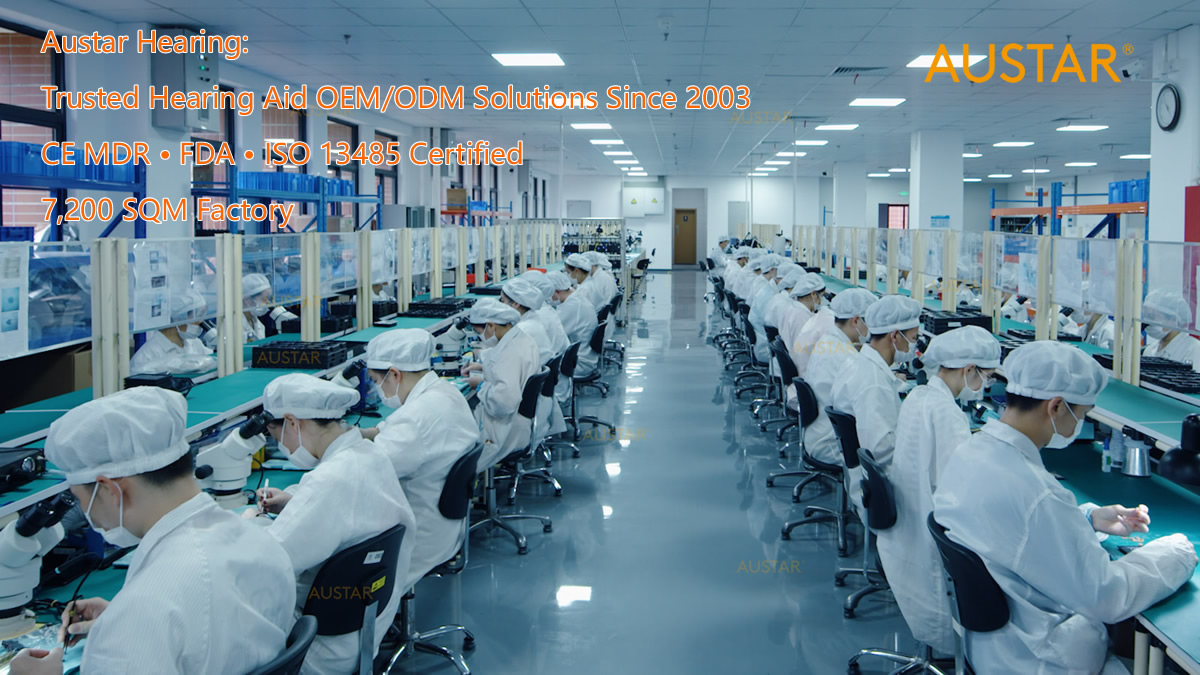
Industry Insight: Global hearing aid manufacturers like Austar Hearing focus on R&D to bridge the gap between high-end technology and affordability, providing practical OEM/ODM solutions for the international market.

Hearing Aid OEM Manufacturer

4. Connectivity and Modern Features

Modern devices are now smart wearables. Consider these added benefits:

  • Bluetooth Streaming: Connect directly to smartphones for calls and music.
  • Rechargeability: Eliminates the need for small disposable batteries.
  • Frequency Lowering: Crucial for those with severe high-frequency loss to improve speech understanding.

5. The Adjustment Period

A hearing aid fitting is not a one-time transaction; it is a journey. Your brain needs 2 to 4 weeks to adapt to new sounds. Professional follow-up sessions are essential for fine-tuning the device as you acclimate.

As a leading hearing aid manufacturer since 2003, Austar Hearing emphasizes that the best device is one that matches both your clinical needs and your lifestyle. Always prioritize professional fitting services and reliable after-sales support.

2026-04-30
Don’t Let a Summer Vacation Damage Your Hearing Aids

Don’t Let a Summer Vacation Damage Your Hearing Aids

While today’s hearing aids are designed to protect against moisture, dirt, and debris, they are not indestructible. If you’re going on vacation this summer, your getaway may present several situations that could potentially damage your hearing aids. Exposing yourself to extreme heat and humidity or jumping into the pool without taking out your hearing aids could lead to costly repairs and extra visits to your hearing care professional’s office. Wherever your travels take you this summer, keep the following tips in mind.

For those who prefer the ocean…
When visiting a tropical paradise, the three biggest threats to your hearing instruments are water, humidity, and sand.

WATER
As of today, there are currently no hearing aids on the market that are labeled as waterproof. Some devices may be able to withstand more exposure to moisture than others, but in general you should try to keep your devices dry and away from the pool or ocean. Keep your hearing aids stored in a secure case while tanning or swimming, as even a small amount of water can damage the microphone, receiver, tubing, and more.

HUMIDITY
If you wear glasses, you have probably noticed that a layer of steam appears on the lenses when you move from a humid area to an air-conditioned one. This condensation may be harmless for your glasses, but it can cause serious damage to a hearing aid if left unchecked. You may need to remove your hearing aids often in humid environments to dry them, or you may consider purchasing an electric hearing aid dryer.

SAND
It’s not uncommon to find sand in your ears or pockets days after visiting the beach. These fine grains stick to anything, and your hearing aids are no exception. Before you reinsert your hearing aids, wash your hands thoroughly to prevent any excess sand from clogging your device and causing problems with functionality.

For hikers and adventurers…
Whether you are exploring the Grand Canyon or biking through a trail, you’ll want to have your hearing aids with you to take in all the breathtaking sounds nature has to offer. With the proper maintenance and care, you can keep your hearing aids functioning optimally no matter your lifestyle or level of activity.

If your vacations involve a lot of exercise, you should be prepared to fight against sweat and heat as well as high winds and debris.

SWEAT
As mentioned above, hearing aids are designed to fight back against only a moderate amount of moisture exposure and will not react well to being drenched. Try to keep a sweat rag with you to wipe excess perspiration away from your ears. If you’re prone to sweating, consider purchasing some nylon hearing aid sleeves to keep your devices dry.

HEAT
Your hearing aids should be shielded from extreme heat sources to keep their internal parts from becoming damaged. When not in use, your hearing aids should be stored in a dry, cool area away from windows or direct sunlight.

HIGH WINDS AND DUST
Certain dry areas, particularly in the Midwestern United States, can generate high amounts of wind that blow around dust and other particles. You wouldn’t want to inhale this dust, and neither do your hearing aids—keep a hearing aid cleaning kit with you at all times to unclog any debris.

Daily maintenance is key
While these conditions are more extreme than what you will experience on a daily basis with a hearing aid, it is still important to begin a routine of cleaning your devices daily to prevent any performance issues. For more information on how to clean and maintain your hearing aids, please click here.

If you are planning a vacation this summer, we also suggest scheduling an appointment with a hearing care professional to have your hearing and devices tested to ensure they are working their best. This way, you will be more prepared to enjoy your time off without having to worry about fixing your device—just don’t forget to bring extra batteries in case of an emergency!
2020-06-22
What to do if a six-month child has not passed hearing test?

What to do if a six-month child has not passed hearing test?

What to do if a six-month child has not passed hearing test?
Baby hearing test is generally taken when baby is seven days after delivery, 42 days after delivery, and three to six months. If a six-month baby fails hearing test, I don't know how many times he fails before. If it has never been tested before, then the result of the first screening is likely to be inaccurate, or temporary. It is recommended to continue the test in two days.

The causes of inaccurate screening include cold, stuffy nose, fever, sore throat, cough, children's milk, choking milk and so on. In order to ensure the accuracy of screening, attention should be paid during hearing screening to avoid hearing screening under the above circumstances (if the screening fails due to the above reasons, timely medical intervention and good prognosis). It is recommended that the cold and After the improvement of throat pain, fever and other conditions, continue to screen.

If the results of multiple tests are the same, first of all, we need to see if there is any foreign body in baby’s ear canal or if there is fluid in the middle ear, then we need to do a cochlear vestibule test to see if it is a problem of cochlear vestibule development. Finally, we need to do a brainstem auditory evoked potential test to confirm. If any problem is found, corresponding measures shall be taken immediately, such as manual intervention e.g. wearing hearing aids.

Most of hearing test are a false alarm, once twice did not pass, and finally passed. In terms of baby's hearing, I need to remind you that when your baby is full of sleep and food after delivery, you should prepare more colorful things. It's the best to be active, to exercise your baby's eyesight, and some sound things, such as wind bells or some toys, to exercise the baby's hearing. Parents can also take a small bell in the baby The left side of the baby's ears and the right side of the baby's ears can also observe the baby's hearing.
2020-06-17
What are the specific functions of hearing aids?

What are the specific functions of hearing aids?

What are the specific functions of hearing aids?


Hearing aid uses the acoustic principle to amplify the sound wave and transmit it to the ear, so that the hearing loss user can hear the sound. Nowadays, there are many kinds of full digital multi-channel hearing aids. The advantages of wearing hearing aids are mainly to compensate for hearing, positioning, improve speech recognition rate, etc.. In terms of function, they mainly include the improvement of intelligent scene recognition, noise reduction, microphone technology, compression, frequency shift and other advanced technologies, which will also help patients in terms of speech clarity of various frequencies. When we confirm the hearing loss, we choose a hearing aid suitable for ourselves, and the next work is hearing rehabilitation. Although hearing aids will not improve your hearing loss, they will slow down your hearing loss. After a period of wearing, speech and voice stimulation, speech resolution will gradually improve. That is to say, as long as you wear hearing aids all the year round, you will hear more clearly than before on the basis of hearing. Hearing aids suggest that the majority of hearing aid wearers should not only wear hearing aids when they need them, but keep wearing. Sound is everywhere, and only by keeping to wearing hearing aids can they benefit.

In addition, hearing aids should be professionally matched, and the right one is the best. Once hearing loss is found, seek medical advice in time, find out, treat and intervene with hearing aids as early as possible. The wearing effect of hearing aids is actually different from person to person. Even if the same hearing aid is used, the wearing effect of different hearing loss may vary greatly. Each person's hearing situation and nature are different, and the scene demand is also different. Therefore, it is better to recommend the wearer to go to a professional hearing test center for audition experience evaluation before selecting it.


2020-06-12
How can hearing aids keep away from moisture? Use tips

How can hearing aids keep away from moisture? Use tips

How can hearing aids keep away from moisture? Use tips


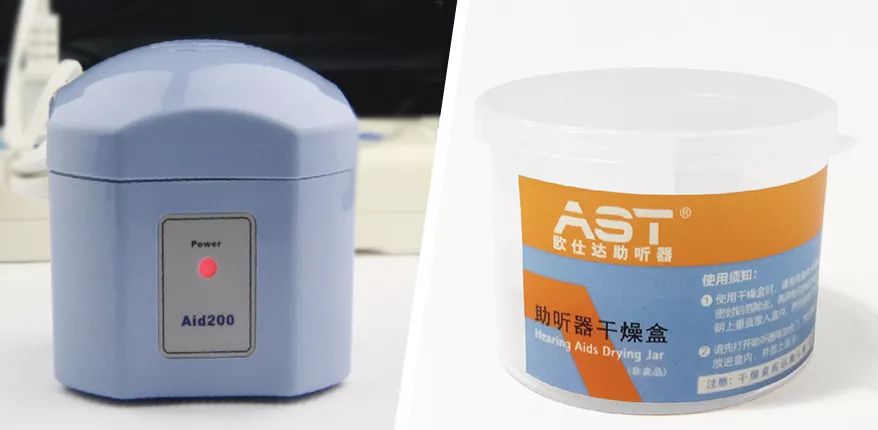
The hearing aid needs to be waterproof and moisture-proof during use. Generally, it needs to be maintained in the fitting center once every three months. In summer and winter, it can be maintained once every month. During daily use, attention should be paid to waterproof. It shall be removed when take a shower and face washing. When resting, open the battery compartment and put it in the drying box for drying. If the water is not careful, do not use the hair dryer to dry it.


We need to know that hearing aids are sophisticated electronic devices. Once its chip is corroded, it will affect the performance of hearing aid. So we must pay attention to waterproof and moisture-proof. First of all, do not wear hearing aids in rainy days or when wash your face, head, bath, swim. Secondly, in summer, sweat should be wiped in time to keep the hearing aid dry and prevent sweat from invading and corroding the machine. In addition, those who wear ear back hearing aids should pay attention to whether there is water or damp in the acoustic pipe, and if it is blocked, it should be cleaned and dried in time. Besides, hearing aid should be regularly maintained and dehumidified. To sleep, take off the battery compartment, open it and put it in the drying box. If you don't wear a hearing aid for a long time, take out the battery and put it in the drying box or electronic nursing treasure. Also pay attention to the color of the drying material in the drying box, and replace it if it fails.

2020-06-10
Can mild hearing loss heal itself?

Can mild hearing loss heal itself?

Can mild hearing loss heal itself?


It depends on the cause of hearing loss and whether there is hearing loss. Although it is only "mild", not all cases can self-healing. In pure tone audiometry, the four frequencies of 500, 1000, 2000 and 3000 Hz are called language frequencies. To evaluate the degree of hearing loss, it refers to the average of these four frequency thresholds (the minimum intensity of a pure tone just heard). When the average is less than 25dB, hearing is in the normal range.

The auditory system is the same as other organs. When cells and organs are over stimulated and experience over activity, the energy or ability to respond to the stimulation will be lost, resulting in hearing loss. Hearing loss can be temporary or permanent, which is related to whether the hair cells are damaged. If hearing hair cells are damaged, irreversible hearing loss will occur. Therefore, whether the hearing loss can heal itself or even be cured has nothing to do with the degree. After all, auditory hair cell damage can also be small-scale, so even "mild" may be permanent; and some factors, such as knock, poisoning, disease and other causes of deafness, although the hearing loss is serious for a time, it can be recovered.

The frequency threshold of hearing mentioned above. Generally speaking, high frequency hearing loss is not easy to recover, while low frequency hearing loss is better to recover. In fact, 25% - 40% of the patients with mild hearing loss have difficulty in understanding speech information. Therefore, although it is "mild", it is not light.

However, no matter what kind of reasons and the extent of hearing loss, it is necessary to intervene. Early treatment is of great significance in saving hearing.

2020-05-27
Can mild hearing loss heal itself?

Can mild hearing loss heal itself?

Can mild hearing loss heal itself?

It depends on the cause of hearing loss and whether there is hearing loss. Although it is only "mild", not all cases can self-healing. In pure tone audiometry, the four frequencies of 500, 1000, 2000 and 3000 Hz are called language frequencies. To evaluate the degree of hearing loss, it refer to the average of these four frequency thresholds (the minimum intensity of a pure tone just heard). When the average is less than 25dB, hearing is in the normal range.

The auditory system is the same as other organs. When cells and organs are over stimulated and experience over activity, the energy or ability to respond to the stimulation will be lost, resulting in hearing loss. Hearing loss can be temporary or permanent, which is related to whether the hair cells are damaged. If hearing hair cells are damaged, irreversible hearing loss will occur. Therefore, whether the hearing loss can heal itself or even be cured has nothing to do with the degree. After all, auditory hair cell damage can also be small-scale, so even "mild" may be permanent; and some factors, such as knock, poisoning, disease and other causes of deafness, although the hearing loss is serious for a time, it can be recovered.

For frequency threshold of hearing mentioned above, generally speaking, high frequency hearing loss is not easy to recover, while low frequency hearing loss is better to recover. In fact, 25% - 40% of the patients with mild hearing loss have difficulty in understanding speech information. Therefore, although it is "mild", it is not light.

However, no matter what kind of reasons and the degree of hearing loss, it is necessary to intervene. Early treatment is of great significance in saving hearing.

The so-called power of hearing aid refers to the ability of hearing aid to enlarge sound. Hearing aids with different power are suitable for people with different degrees of hearing loss, which is the key to select hearing aids. It is generally believed that 0-25db is normal; 26-40dB is mild hearing loss, without hearing aids; 41-55db is moderate hearing loss, with small and medium power hearing aids; 56-70db is moderate and severe hearing loss, and 71-80db is severe hearing loss, with medium and high power hearing aids optional; Over 81dbs are extremely severe hearing loss, and can wear extremely powerful hearing aids.
2020-05-26
How often do I change the ear dome of hearing aid?

How often do I change the ear dome of hearing aid?

How often do I change the ear dome of hearing aid?


It is determined by the color and texture of ear dome. Normal ear dome is bright white, soft and elastic. If it turns yellow and hard, it should be replaced. The specific replacement frequency depends on the use and care of each person. Generally, patients with otitis media and those with oily ear secretion should be replace ear dome more frequently and may use new ear dome every two or three months. Generally it should be replaced every six months with good care.


If it's the ear dome or ear mold used by a child, the child's ear mold should be replaced more frequently. Because the length of the child's ear changes rapidly, the ear mold needs to be replaced in about 3 months, and the replacement time will be shorter when the child is a little older. If it is an adult ear mold it depends on whether the user has the intention to protect it. Generally speaking, the ear mold needs to be replaced if it is damaged or blocked. 3-6 months to the hearing center regularly for cleaning. In daily life, the hearing aid should pay attention to damp-proof (to avoid large temperature difference, heavy moisture), waterproof (do not wear it when washing your face or bathing), prevent falling (avoid little children and animals touch hearing aids. When wearing, try to sit on soft places, such as sofa or bed) and prevent corrosion (do not use alcohol to wipe the device; replace the battery in time, and remember to remove the battery to avoid battery leakage and corrosion if don’t use the device for long time). You usually needs to clean earwax, or regularly send to the Hearing Center for cleaning.


2020-05-23
Can hearing aids be recycled?

Can hearing aids be recycled?

Can hearing aids be recycled?

From the perspective of commodities, it is only a form of preferential activities or feedback to customers from manufacturers or distributors. With the development of science and technology, the new generation of hearing aids is just like the current electronic products, and new products will come out every one or two years. In general, the average time for ordinary users to use hearing aids is about 5 years, during which a lot of new products have come out.


Considering the particularity of products, the problem of discontinuation of production, lack of repair parts etc., the greater difference between hearing aids and other electronic products lies in the use environment and frequency. Some people say that the use frequency of mobile phones is also very high, but mobile phones generally do not face sweat, earwax and wet ear canal environment. Hearing aids are often hung behind or plugged in the ear canal. In addition to paying attention to maintenance and avoiding falling, after-sales service and maintenance problems are also very important.


So it doesn't make much sense to recycle the hearing aid. Our hearing center will not recycle the old hearing aids when it carries out the “old for new” promotion. Customers will test and match new hearing aids with relative discount based on their old ones. In addition to the reasons mentioned above, there are also reasons such as children changing hearing aids. Most of the time, the used children hearing aids are relatively new. Parents want to use new technology and then change their children’s hearing aids. At this time, the data of old hearing aids detected by hearing aids analyzer is up to standard, which can be recycled. However, considering that children are generally lively and active, it is more meaningful for customers to keep the old ones for backup.


2020-05-22
Which brand of hearing aid is more cost-effective? Which brand of hearing aid is better?

Which brand of hearing aid is more cost-effective? Which brand of hearing aid is better?

Which brand of hearing aid is more cost-effective? Which brand of hearing aid is better?

It is recommended to go to the local professional hearing aid fitting institutions. There are many hearing aid brands in the market, such as: "Phonak,Resound, Starkey, Siemens, Lisound, Oticon, Austar, Unicorn, etc., which brand of hearing aid is better?

First of all, choose a right brand. We need to know manufacturers of hearing aid. In terms of R & D institutions, manufacturer scale, product quality, technical level, after-sales service and other issues, our Chinese market has four major brands: Phonak, Resound, Starkey, Siemens. These four brands are quite good in the hearing aid industry, and each brand of hearing aid has its own special features. We need to see patient's own hearing loss to determine which manufacturer's hearing aids are more suitable for them. Hearing aids have different sound quality and different hearing effects, so it's not easy to choose a more suitable hearing aid. Not everyone wearing a hearing aid has the same effect. The most important thing is to see the degree of hearing loss and speech recognition ability of the patient, so as to determine the effect of listening. At the beginning, wearing a hearing aid may not all be able to hear. It takes a long time to hear and understand. It needs to be worn slowly to adapt to the sounds heard in different environments. In general, it will be able to fully adapt to this hearing aid in six months or so.


It must be firmly believed that the longer to wear hearing aid, the better to hear. To hear the voice that couldn't be heard before, from the silent world to the sound world. You can hear all kinds of beautiful sounds of nature, and can communicate with family and friends to improve the quality of life.


2020-05-15